

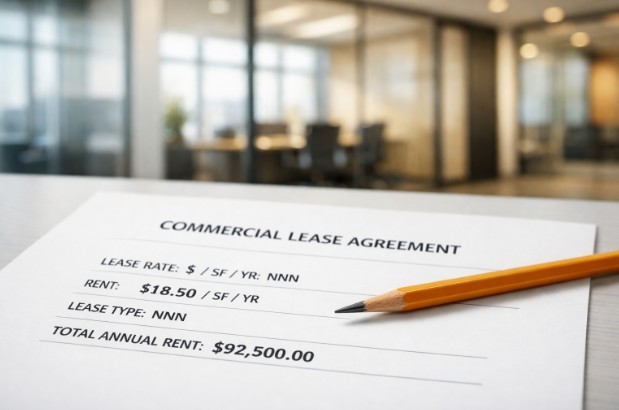
SF/YR means dollars per square foot per year. When a commercial real estate listing quotes a rent of $30 SF/YR for a 2,000-square-foot space, the annual base rent is $60,000—or $5,000 per month—before any additional charges that are not included in the quoted rate.
Commercial lease rates are commonly presented as an annual dollar amount per square foot, which makes it easier to compare properties of different sizes. The same notation may appear as $/SF/YR, PSF/YR, annual PSF, or per square foot annually.
That calculation is straightforward. Determining the property’s true rent, occupancy cost, or investment income requires a closer look at the lease structure. Common area maintenance charges, property taxes, insurance, utilities, rent increases, expense caps, and landlord responsibilities can materially change the economics.
This guide explains how investors can interpret SF/YR, calculate annualized commercial rent, account for CAM and NNN charges, and compare listings on a consistent basis. As a nationwide investment real estate resource, Brisky helps buyers and sellers look beyond the advertised rate and evaluate the lease, property, tenant, and income together.

What Does SF/YR Mean in a Commercial Real Estate Listing?
SF/YR tells you how many dollars are charged for each square foot of space during one year.
For example:
$25 SF/YR × 4,000 SF = $100,000 in annual rent
Dividing the annual amount by 12 produces the monthly base rent:
$100,000 ÷ 12 = $8,333.33 per month
The abbreviation does not, by itself, identify what is included in the rate. A listing might quote $25 SF/YR as base rent under a triple net lease, or it might quote a gross rate that includes certain property expenses. The wording around the rate is therefore just as important as the number.
| Listing notation | What it generally indicates |
|---|---|
| $30 SF/YR | $30 per square foot each year; inclusions must be confirmed |
| $2.50 SF/MO | $2.50 per square foot each month, equal to $30 SF/YR |
| $30 SF/YR NNN | Usually $30 of base rent plus separately paid NNN expenses |
| $30 SF/YR + $8 NNN | $30 base rent plus an estimated $8 per square foot in pass-through expenses |
| $38 SF/YR gross | A gross rate that includes specified expenses, subject to the lease |
| $30 modified gross | Expenses are divided between landlord and tenant according to negotiated terms |
The safest approach is to treat SF/YR as a unit of measurement, not a complete description of the lease.
How Do You Calculate Annual and Monthly Commercial Rent?
To calculate annual base rent from an SF/YR quote, multiply the rate by the applicable square footage.
Annual commercial rent formula
Annual base rent = SF/YR rate × rentable square feet
Monthly commercial rent formula
Monthly base rent = annual base rent ÷ 12
Assume a 3,000-square-foot space is quoted at $28.50 SF/YR:
$28.50 × 3,000 = $85,500 annual base rent
$85,500 ÷ 12 = $7,125 monthly base rent
You can also work backward when a listing provides only the monthly rent.
Converting monthly rent to SF/YR
SF/YR rate = monthly rent × 12 ÷ square feet
Using the same example:
$7,125 × 12 ÷ 3,000 = $28.50 SF/YR
These formulas let investors normalize different listing formats. One property may advertise an annual rate, another may show a monthly total, and a third may provide only scheduled annual rent. Converting each property to both annual dollars and dollars per square foot creates a consistent starting point.
Does SF/YR Include CAM Charges, Taxes, or Insurance?
No—not automatically. Whether SF/YR includes operating expenses depends on the lease type and the language used in the listing.
A commercial lease is a contract that establishes the parties’ payment terms, maintenance responsibilities, and other obligations. Marketing shorthand can summarize those terms, but the signed lease and amendments ultimately control.
Three common structures illustrate the differences:
- Gross lease
- In a gross lease, the landlord generally pays specified property operating expenses and accounts for those costs when establishing the rent. Utilities, expense increases, after-hours services, and other items may still be charged separately.
- Modified gross lease
- A modified gross lease divides expenses between the landlord and tenant. The tenant might pay base rent and utilities while the landlord pays taxes and insurance, or the parties may negotiate another allocation.
- Triple net lease
- Under a triple net lease, the tenant generally pays base rent plus property taxes, building insurance, and maintenance or CAM expenses. Cornell’s Legal Information Institute describes a net lease as one in which the tenant pays base rent plus some or all operating and maintenance expenses.
Consequently, these two quotes are not equivalent:
- $30 SF/YR gross
- $30 SF/YR NNN plus $8.50 in estimated expenses
The second quote has an estimated occupancy cost of $38.50 SF/YR before utilities and any other separately charged items. Comparing only the $30 headline rates would understate the cost of the NNN option.
What Are CAM Charges in Commercial Rent Pricing?
CAM stands for common area maintenance. CAM charges reimburse the landlord for eligible costs associated with operating and maintaining shared portions of a commercial property.
Depending on the property and lease, CAM expenses may include parking lot maintenance, landscaping, snow removal, security, common-area lighting, shared restrooms, cleaning, property management, repairs, and other operating costs. The exact inclusions and exclusions must be determined from the lease.
In a multi-tenant retail center, a tenant’s share is often based on its proportionate share of the property.
Pro rata CAM formula
Tenant’s pro rata share = tenant square footage ÷ applicable property square footage
Assume a tenant occupies 2,400 square feet in a 60,000-square-foot shopping center:
2,400 ÷ 60,000 = 4% pro rata share
If the center has a $510,000 recoverable annual operating budget, the tenant’s estimated share would be:
$510,000 × 4% = $20,400 annually
Converted to a per-square-foot rate:
$20,400 ÷ 2,400 = $8.50 SF/YR
Actual leases can use a different denominator. Certain anchor spaces, vacant suites, separately maintained areas, or expenses that benefit only part of a property may be included or excluded. Investors should confirm the lease-defined denominator rather than assuming that pro rata share is always based on total building area.
CAM payments are also commonly estimated during the year and reconciled against actual expenses. A tenant may receive a credit or an additional bill after the annual reconciliation. Investors should examine historical reconciliations, expense caps, administrative fees, exclusions, audit rights, and the treatment of capital expenditures.
What Is the NNN Rent Formula?
A basic NNN calculation combines annual base rent with estimated pass-through expenses.
- Annual base rent
- Square feet × base rent per SF/YR
- Annual NNN expenses
- Square feet × estimated NNN rate per SF/YR
- Estimated monthly payment
- Square feet × (base rate + NNN rate) ÷ 12
For example, a 2,000-square-foot space quoted at $30 SF/YR plus $5 SF/YR in estimated NNN charges would produce:
- Annual base rent: 2,000 × $30 = $60,000
- Annual NNN charges: 2,000 × $5 = $10,000
- Estimated annual occupancy cost: $70,000
- Estimated monthly payment: $70,000 ÷ 12 = $5,833.33
This is an estimating formula rather than a substitute for lease review. A tenant may pay certain expenses directly to a taxing authority, insurer, utility, or contractor instead of reimbursing the landlord. Some leases also leave structural, roof, parking lot, or capital obligations with the owner.
Brisky’s related guide provides a more detailed walkthrough of how to calculate a triple net lease. The present article focuses specifically on decoding SF/YR and using it to compare investment listings.

Retail Example: What Does $32 SF/YR Plus $8.50 NNN Cost?
Consider a 2,400-square-foot retail suite with the following advertised terms:
- Base rent: $32 SF/YR
- Estimated combined NNN charges: $8.50 SF/YR
- Space: 2,400 square feet
The calculation is:
| Rent component | Annual amount | Monthly amount |
|---|---|---|
| Base rent | $32 × 2,400 = $76,800 | $6,400 |
| Estimated NNN charges | $8.50 × 2,400 = $20,400 | $1,700 |
| Estimated total | $97,200 | $8,100 |
The estimated all-in rate is: $32 + $8.50 = $40.50 SF/YR
This figure still may not include separately metered utilities, trash service, percentage rent, marketing assessments, after-hours HVAC, or other tenant-specific costs.
From an investor’s perspective, the $20,400 of reimbursements should not automatically be treated as additional profit. The reimbursements may offset taxes, insurance, maintenance, management, and other property expenses. Underwriting should show both the reimbursement income and the expenses it is intended to recover.
Investors should also ask whether expense recoveries are complete. Caps, exclusions, vacant-space treatment, negotiated tenant protections, and unrecoverable ownership costs can create expense leakage even when a lease is described as NNN.
Net Lease Property Example: How Does SF/YR Relate to NOI and Cap Rate?
SF/YR can also help an investor translate a single-tenant net lease into annual contractual income.
Assume a 5,000-square-foot freestanding retail property has:
- Base rent: $30 SF/YR
- Annual base rent: $150,000
- Asking price: $2,500,000
The annual rent calculation is:
5,000 × $30 = $150,000
If the tenant pays all operating expenses and the owner has no unreimbursed property-level expenses, the preliminary capitalization rate would be:
$150,000 ÷ $2,500,000 = 6.00%
Now assume the lease or property records reveal $12,000 in annual owner-paid expenses that are not reimbursed. Estimated net operating income would decrease to $138,000:
$138,000 ÷ $2,500,000 = 5.52%
The property is still advertised at $30 SF/YR, but its investment return changes after the remaining landlord obligations are incorporated.
This illustrates an important distinction:
SF/YR is an income input. It is not a complete valuation conclusion.
An investor must still evaluate net operating income, purchase price, lease term, tenant credit, rent increases, options, guarantee structure, property condition, replacement-rent risk, and remaining owner responsibilities.
How Do Investors Compare Commercial Listings on an Apples-to-Apples Basis?
Investors can compare commercial real estate listings more accurately by converting each opportunity to the same annual basis and separating contractual base rent from expense reimbursements.
- Normalize the rent period
Convert monthly quotes to annual dollars and convert annual totals to SF/YR. This eliminates confusion between $2.50 SF/MO and $30 SF/YR, which represent the same rate.
- Identify base rent versus total occupancy cost
Determine whether the advertised rate is base rent, gross rent, modified gross rent, or NNN rent. List each additional expense separately.
- Confirm the square-footage basis
Ask whether the rate applies to usable area, rentable area, gross leasable area, or another lease-defined measurement. BOMA’s floor measurement standards emphasize rentable area as a key leasing and expense-allocation metric, but the appropriate standard and terminology can vary by property type.
A difference between 2,000 usable square feet and 2,300 rentable square feet can materially change annual rent when the rate applies to the larger figure.
- Distinguish current rent from projected rent
Offering memoranda may show current contractual rent, scheduled future rent, market rent, or a broker’s pro forma. Investors should label each number clearly and avoid capitalizing future rent as though it were already being collected.
- Model rent escalations
For fixed annual increases, the future rate can be estimated as:
Future rate = current rate × (1 + annual increase)ⁿ
Here, n is the number of increases that have occurred.
For example, $30 SF/YR with 2% annual increases becomes approximately $31.21 SF/YR after two increases.
- Review concessions and landlord costs
Free rent, tenant improvement allowances, leasing commissions, landlord work, and delayed rent commencement can reduce effective income. These items may not appear in the advertised SF/YR rate.
- Compare NOI and risk—not SF/YR alone
Consider two hypothetical properties:
| Property | Size | Rent | Annual Base Rent | Price | Preliminary Cap Rate |
| Small QSR | 2,500 SF | $45 SF/YR | $112,500 | $1,875,000 | 6.00% |
| Larger retail store | 10,000 SF | $12 SF/YR | $120,000 | $2,000,000 | 6.00% |
The QSR has a much higher rent per square foot, yet the two examples produce similar preliminary cap rates. Their actual investment profiles could still differ substantially because of lease term, tenant strength, building specialization, location, rent growth, and residual value.
A higher SF/YR number is not automatically a better investment.
Why Does Location Affect SF/YR and Rent Durability?
Location can influence both the rent a tenant is willing to pay and the likelihood that the tenant can sustain that rent.
The U.S. Small Business Administration advises businesses to consider target markets, costs, zoning, taxes, regulations, utilities, insurance, and other location-specific factors when selecting a site. Rental rates and other operating expenses can vary significantly between locations.
For a commercial real estate investor, the relevant question is not merely, “Is this rent high?” It is:
Is the rent supportable for this tenant, property, and market over the remaining lease term?
Factors that can affect the answer include access, visibility, traffic patterns, local demographics, nearby competition, zoning, property taxes, labor availability, utilities, building functionality, and alternative uses.
A below-market rent may provide future upside at renewal. An above-market rent may create rollover risk if a tenant leaves or demands a reduction. SF/YR becomes more useful when it is compared with local market rents, tenant economics, and the property’s physical utility.
What Common SF/YR Mistakes Should Investors Avoid?
Several recurring mistakes can distort commercial rent analysis:
- Reading an annual rate as a monthly rate. A quote of $30 SF/YR equals $2.50 per square foot per month—not $30 per square foot each month.
- Assuming the rate is all-inclusive. SF/YR does not reveal CAM, taxes, insurance, utilities, or other charges unless the listing identifies them.
- Comparing gross rent with NNN base rent. The lease structures must be normalized before the rates are compared.
- Using the wrong square footage. Rent may be charged on rentable area rather than the area the occupant uses exclusively.
- Treating reimbursements as profit. CAM and NNN recoveries may offset operating expenses rather than increase net income dollar for dollar.
- Ignoring rent steps and concessions. Current rent, average rent, effective rent, and future rent can produce different underwriting results.
- Relying only on the marketing package. The lease, amendments, rent roll, estoppel certificate, expense reconciliations, tax bills, insurance records, and operating statements should support the advertised figures.
All examples in this article are illustrative. Actual rights, expenses, and payment responsibilities are determined by the applicable lease documents and law.
Frequently Asked Questions About SF/YR
What does $25 SF/YR mean?
It means the annual rent is $25 for every applicable square foot. For 4,000 square feet, the annual rent is $100,000 and the monthly base rent is approximately $8,333.33.
How do you convert monthly commercial rent to SF/YR?
Multiply the monthly rent by 12 and divide the result by the applicable square footage:
Monthly rent × 12 ÷ square feet = SF/YR
Is SF/YR base rent or total rent?
It can represent either, depending on the listing. A quote labeled NNN generally refers to base rent before NNN expenses, while a gross quote may include specified expenses. Confirm the structure and inclusions.
Is CAM the same as NNN?
No. CAM is one category of property expense. A combined NNN charge generally includes property taxes, insurance, and maintenance or CAM, although the precise categories depend on the lease.
Does a NNN rate include utilities?
Not necessarily. Utilities may be paid directly by the tenant, reimbursed to the landlord, included in CAM, or handled under another lease provision.
What does “$30 NNN plus $7” mean?
It generally means $30 SF/YR in base rent plus an estimated $7 SF/YR in NNN expenses, for an estimated combined cost of $37 SF/YR before other separately charged items.
Can investors use SF/YR to calculate a cap rate?
SF/YR can be used to calculate annual rent, which is an input in the NOI analysis. Cap rate is based on net operating income divided by property price, so unreimbursed expenses must also be considered.
What documents verify the advertised commercial rent?
Investors commonly review the signed lease, amendments, rent roll, tenant estoppel, operating statements, expense reconciliations, tax bills, insurance records, and applicable service contracts.
Evaluate SF/YR and CRE Opportunities With Brisky
Understanding SF/YR is the first step in reading a commercial real estate listing. Sound investment analysis goes further by identifying what the rate includes, converting it to annual dollars, verifying the applicable square footage, modeling CAM and NNN expenses, and reconciling the result to actual net operating income.
Brisky’s team works with commercial real estate buyers and sellers on underwriting, property evaluation, market knowledge, opportunity sourcing, and transaction guidance. Learn more about Brisky, explore Brisky’s commercial real estate investment services, or review the company’s current commercial property inventory.
For help interpreting a lease, comparing net lease opportunities, or evaluating the income behind a listing, contact Brisky.
SF/YR means dollars per square foot per year. When a commercial real estate listing quotes a rent of $30 SF/YR for a 2,000-square-foot space, the annual base rent is $60,000—or $5,000 per month—before any additional charges that are not included in the quoted rate.
Commercial lease rates are commonly presented as an annual dollar amount per square foot, which makes it easier to compare properties of different sizes. The same notation may appear as $/SF/YR, PSF/YR, annual PSF, or per square foot annually.
That calculation is straightforward. Determining the property’s true rent, occupancy cost, or investment income requires a closer look at the lease structure. Common area maintenance charges, property taxes, insurance, utilities, rent increases, expense caps, and landlord responsibilities can materially change the economics.
This guide explains how investors can interpret SF/YR, calculate annualized commercial rent, account for CAM and NNN charges, and compare listings on a consistent basis. As a nationwide investment real estate resource, Brisky helps buyers and sellers look beyond the advertised rate and evaluate the lease, property, tenant, and income together.
What Does SF/YR Mean in a Commercial Real Estate Listing?
SF/YR tells you how many dollars are charged for each square foot of space during one year.
For example:
$25 SF/YR × 4,000 SF = $100,000 in annual rent
Dividing the annual amount by 12 produces the monthly base rent:
$100,000 ÷ 12 = $8,333.33 per month
The abbreviation does not, by itself, identify what is included in the rate. A listing might quote $25 SF/YR as base rent under a triple net lease, or it might quote a gross rate that includes certain property expenses. The wording around the rate is therefore just as important as the number.
|
Listing notation |
What it generally indicates |
|
$30 SF/YR |
$30 per square foot each year; inclusions must be confirmed |
|
$2.50 SF/MO |
$2.50 per square foot each month, equal to $30 SF/YR |
|
$30 SF/YR NNN |
Usually $30 of base rent plus separately paid NNN expenses |
|
$30 SF/YR + $8 NNN |
$30 base rent plus an estimated $8 per square foot in pass-through expenses |
|
$38 SF/YR gross |
A gross rate that includes specified expenses, subject to the lease |
|
$30 modified gross |
Expenses are divided between landlord and tenant according to negotiated terms |
The safest approach is to treat SF/YR as a unit of measurement, not a complete description of the lease.
How Do You Calculate Annual and Monthly Commercial Rent?
To calculate annual base rent from an SF/YR quote, multiply the rate by the applicable square footage.
Annual commercial rent formula
Annual base rent = SF/YR rate × rentable square feet
Monthly commercial rent formula
Monthly base rent = annual base rent ÷ 12
Assume a 3,000-square-foot space is quoted at $28.50 SF/YR:
$28.50 × 3,000 = $85,500 annual base rent
$85,500 ÷ 12 = $7,125 monthly base rent
You can also work backward when a listing provides only the monthly rent.
Converting monthly rent to SF/YR
SF/YR rate = monthly rent × 12 ÷ square feet
Using the same example:
$7,125 × 12 ÷ 3,000 = $28.50 SF/YR
These formulas let investors normalize different listing formats. One property may advertise an annual rate, another may show a monthly total, and a third may provide only scheduled annual rent. Converting each property to both annual dollars and dollars per square foot creates a consistent starting point.
Does SF/YR Include CAM Charges, Taxes, or Insurance?
No—not automatically. Whether SF/YR includes operating expenses depends on the lease type and the language used in the listing.
A commercial lease is a contract that establishes the parties’ payment terms, maintenance responsibilities, and other obligations. Marketing shorthand can summarize those terms, but the signed lease and amendments ultimately control.
Three common structures illustrate the differences:
- Gross lease
- In a gross lease, the landlord generally pays specified property operating expenses and accounts for those costs when establishing the rent. Utilities, expense increases, after-hours services, and other items may still be charged separately.
- Modified gross lease
- A modified gross lease divides expenses between the landlord and tenant. The tenant might pay base rent and utilities while the landlord pays taxes and insurance, or the parties may negotiate another allocation.
- Triple net lease
- Under a triple net lease, the tenant generally pays base rent plus property taxes, building insurance, and maintenance or CAM expenses. Cornell’s Legal Information Institute describes a net lease as one in which the tenant pays base rent plus some or all operating and maintenance expenses.
Consequently, these two quotes are not equivalent:
- $30 SF/YR gross
- $30 SF/YR NNN plus $8.50 in estimated expenses
The second quote has an estimated occupancy cost of $38.50 SF/YR before utilities and any other separately charged items. Comparing only the $30 headline rates would understate the cost of the NNN option.
What Are CAM Charges in Commercial Rent Pricing?
CAM stands for common area maintenance. CAM charges reimburse the landlord for eligible costs associated with operating and maintaining shared portions of a commercial property.
Depending on the property and lease, CAM expenses may include parking lot maintenance, landscaping, snow removal, security, common-area lighting, shared restrooms, cleaning, property management, repairs, and other operating costs. The exact inclusions and exclusions must be determined from the lease.
In a multi-tenant retail center, a tenant’s share is often based on its proportionate share of the property.
Pro rata CAM formula
Tenant’s pro rata share = tenant square footage ÷ applicable property square footage
Assume a tenant occupies 2,400 square feet in a 60,000-square-foot shopping center:
2,400 ÷ 60,000 = 4% pro rata share
If the center has a $510,000 recoverable annual operating budget, the tenant’s estimated share would be:
$510,000 × 4% = $20,400 annually
Converted to a per-square-foot rate:
$20,400 ÷ 2,400 = $8.50 SF/YR
Actual leases can use a different denominator. Certain anchor spaces, vacant suites, separately maintained areas, or expenses that benefit only part of a property may be included or excluded. Investors should confirm the lease-defined denominator rather than assuming that pro rata share is always based on total building area.
CAM payments are also commonly estimated during the year and reconciled against actual expenses. A tenant may receive a credit or an additional bill after the annual reconciliation. Investors should examine historical reconciliations, expense caps, administrative fees, exclusions, audit rights, and the treatment of capital expenditures.
What Is the NNN Rent Formula?
A basic NNN calculation combines annual base rent with estimated pass-through expenses.
- Annual base rent
- Square feet × base rent per SF/YR
- Annual NNN expenses
- Square feet × estimated NNN rate per SF/YR
- Estimated monthly payment
- Square feet × (base rate + NNN rate) ÷ 12
For example, a 2,000-square-foot space quoted at $30 SF/YR plus $5 SF/YR in estimated NNN charges would produce:
- Annual base rent: 2,000 × $30 = $60,000
- Annual NNN charges: 2,000 × $5 = $10,000
- Estimated annual occupancy cost: $70,000
- Estimated monthly payment: $70,000 ÷ 12 = $5,833.33
This is an estimating formula rather than a substitute for lease review. A tenant may pay certain expenses directly to a taxing authority, insurer, utility, or contractor instead of reimbursing the landlord. Some leases also leave structural, roof, parking lot, or capital obligations with the owner.
Brisky’s related guide provides a more detailed walkthrough of how to calculate a triple net lease. The present article focuses specifically on decoding SF/YR and using it to compare investment listings.
Retail Example: What Does $32 SF/YR Plus $8.50 NNN Cost?
Consider a 2,400-square-foot retail suite with the following advertised terms:
- Base rent: $32 SF/YR
- Estimated combined NNN charges: $8.50 SF/YR
- Space: 2,400 square feet
The calculation is:
|
Rent component |
Annual amount |
Monthly amount |
|
Base rent |
$32 × 2,400 = $76,800 |
$6,400 |
|
Estimated NNN charges |
$8.50 × 2,400 = $20,400 |
$1,700 |
|
Estimated total |
$97,200 |
$8,100 |
The estimated all-in rate is: $32 + $8.50 = $40.50 SF/YR
This figure still may not include separately metered utilities, trash service, percentage rent, marketing assessments, after-hours HVAC, or other tenant-specific costs.
From an investor’s perspective, the $20,400 of reimbursements should not automatically be treated as additional profit. The reimbursements may offset taxes, insurance, maintenance, management, and other property expenses. Underwriting should show both the reimbursement income and the expenses it is intended to recover.
Investors should also ask whether expense recoveries are complete. Caps, exclusions, vacant-space treatment, negotiated tenant protections, and unrecoverable ownership costs can create expense leakage even when a lease is described as NNN.
Net Lease Property Example: How Does SF/YR Relate to NOI and Cap Rate?
SF/YR can also help an investor translate a single-tenant net lease into annual contractual income.
Assume a 5,000-square-foot freestanding retail property has:
- Base rent: $30 SF/YR
- Annual base rent: $150,000
- Asking price: $2,500,000
The annual rent calculation is:
5,000 × $30 = $150,000
If the tenant pays all operating expenses and the owner has no unreimbursed property-level expenses, the preliminary capitalization rate would be:
$150,000 ÷ $2,500,000 = 6.00%
Now assume the lease or property records reveal $12,000 in annual owner-paid expenses that are not reimbursed. Estimated net operating income would decrease to $138,000:
$138,000 ÷ $2,500,000 = 5.52%
The property is still advertised at $30 SF/YR, but its investment return changes after the remaining landlord obligations are incorporated.
This illustrates an important distinction:
SF/YR is an income input. It is not a complete valuation conclusion.
An investor must still evaluate net operating income, purchase price, lease term, tenant credit, rent increases, options, guarantee structure, property condition, replacement-rent risk, and remaining owner responsibilities.
How Do Investors Compare Commercial Listings on an Apples-to-Apples Basis?
Investors can compare commercial real estate listings more accurately by converting each opportunity to the same annual basis and separating contractual base rent from expense reimbursements.
- Normalize the rent period
Convert monthly quotes to annual dollars and convert annual totals to SF/YR. This eliminates confusion between $2.50 SF/MO and $30 SF/YR, which represent the same rate.
- Identify base rent versus total occupancy cost
Determine whether the advertised rate is base rent, gross rent, modified gross rent, or NNN rent. List each additional expense separately.
- Confirm the square-footage basis
Ask whether the rate applies to usable area, rentable area, gross leasable area, or another lease-defined measurement. BOMA’s floor measurement standards emphasize rentable area as a key leasing and expense-allocation metric, but the appropriate standard and terminology can vary by property type.
A difference between 2,000 usable square feet and 2,300 rentable square feet can materially change annual rent when the rate applies to the larger figure.
- Distinguish current rent from projected rent
Offering memoranda may show current contractual rent, scheduled future rent, market rent, or a broker’s pro forma. Investors should label each number clearly and avoid capitalizing future rent as though it were already being collected.
- Model rent escalations
For fixed annual increases, the future rate can be estimated as:
Future rate = current rate × (1 + annual increase)ⁿ
Here, n is the number of increases that have occurred.
For example, $30 SF/YR with 2% annual increases becomes approximately $31.21 SF/YR after two increases.
- Review concessions and landlord costs
Free rent, tenant improvement allowances, leasing commissions, landlord work, and delayed rent commencement can reduce effective income. These items may not appear in the advertised SF/YR rate.
- Compare NOI and risk—not SF/YR alone
Consider two hypothetical properties:
|
Property |
Size |
Rent |
Annual Base Rent |
Price |
Preliminary Cap Rate |
|
Small QSR |
2,500 SF |
$45 SF/YR |
$112,500 |
$1,875,000 |
6.00% |
|
Larger retail store |
10,000 SF |
$12 SF/YR |
$120,000 |
$2,000,000 |
6.00% |
The QSR has a much higher rent per square foot, yet the two examples produce similar preliminary cap rates. Their actual investment profiles could still differ substantially because of lease term, tenant strength, building specialization, location, rent growth, and residual value.
A higher SF/YR number is not automatically a better investment.
Why Does Location Affect SF/YR and Rent Durability?
Location can influence both the rent a tenant is willing to pay and the likelihood that the tenant can sustain that rent.
The U.S. Small Business Administration advises businesses to consider target markets, costs, zoning, taxes, regulations, utilities, insurance, and other location-specific factors when selecting a site. Rental rates and other operating expenses can vary significantly between locations.
For a commercial real estate investor, the relevant question is not merely, “Is this rent high?” It is:
Is the rent supportable for this tenant, property, and market over the remaining lease term?
Factors that can affect the answer include access, visibility, traffic patterns, local demographics, nearby competition, zoning, property taxes, labor availability, utilities, building functionality, and alternative uses.
A below-market rent may provide future upside at renewal. An above-market rent may create rollover risk if a tenant leaves or demands a reduction. SF/YR becomes more useful when it is compared with local market rents, tenant economics, and the property’s physical utility.
What Common SF/YR Mistakes Should Investors Avoid?
Several recurring mistakes can distort commercial rent analysis:
- Reading an annual rate as a monthly rate. A quote of $30 SF/YR equals $2.50 per square foot per month—not $30 per square foot each month.
- Assuming the rate is all-inclusive. SF/YR does not reveal CAM, taxes, insurance, utilities, or other charges unless the listing identifies them.
- Comparing gross rent with NNN base rent. The lease structures must be normalized before the rates are compared.
- Using the wrong square footage. Rent may be charged on rentable area rather than the area the occupant uses exclusively.
- Treating reimbursements as profit. CAM and NNN recoveries may offset operating expenses rather than increase net income dollar for dollar.
- Ignoring rent steps and concessions. Current rent, average rent, effective rent, and future rent can produce different underwriting results.
- Relying only on the marketing package. The lease, amendments, rent roll, estoppel certificate, expense reconciliations, tax bills, insurance records, and operating statements should support the advertised figures.
All examples in this article are illustrative. Actual rights, expenses, and payment responsibilities are determined by the applicable lease documents and law.
Frequently Asked Questions About SF/YR
What does $25 SF/YR mean?
It means the annual rent is $25 for every applicable square foot. For 4,000 square feet, the annual rent is $100,000 and the monthly base rent is approximately $8,333.33.
How do you convert monthly commercial rent to SF/YR?
Multiply the monthly rent by 12 and divide the result by the applicable square footage:
Monthly rent × 12 ÷ square feet = SF/YR
Is SF/YR base rent or total rent?
It can represent either, depending on the listing. A quote labeled NNN generally refers to base rent before NNN expenses, while a gross quote may include specified expenses. Confirm the structure and inclusions.
Is CAM the same as NNN?
No. CAM is one category of property expense. A combined NNN charge generally includes property taxes, insurance, and maintenance or CAM, although the precise categories depend on the lease.
Does a NNN rate include utilities?
Not necessarily. Utilities may be paid directly by the tenant, reimbursed to the landlord, included in CAM, or handled under another lease provision.
What does “$30 NNN plus $7” mean?
It generally means $30 SF/YR in base rent plus an estimated $7 SF/YR in NNN expenses, for an estimated combined cost of $37 SF/YR before other separately charged items.
Can investors use SF/YR to calculate a cap rate?
SF/YR can be used to calculate annual rent, which is an input in the NOI analysis. Cap rate is based on net operating income divided by property price, so unreimbursed expenses must also be considered.
What documents verify the advertised commercial rent?
Investors commonly review the signed lease, amendments, rent roll, tenant estoppel, operating statements, expense reconciliations, tax bills, insurance records, and applicable service contracts.
Evaluate SF/YR and CRE Opportunities With Brisky
Understanding SF/YR is the first step in reading a commercial real estate listing. Sound investment analysis goes further by identifying what the rate includes, converting it to annual dollars, verifying the applicable square footage, modeling CAM and NNN expenses, and reconciling the result to actual net operating income.
Brisky’s team works with commercial real estate buyers and sellers on underwriting, property evaluation, market knowledge, opportunity sourcing, and transaction guidance. Learn more about Brisky, explore Brisky’s commercial real estate investment services, or review the company’s current commercial property inventory.
For help interpreting a lease, comparing net lease opportunities, or evaluating the income behind a listing, contact Brisky.