

Appraising commercial real estate is the process of estimating its market value using three primary valuation methods: the Income Capitalization Approach, the Sales Comparison Approach, and the Cost Approach. Each method provides unique insights—when used together, they offer a robust valuation. Below, we’ll explore each one in detail, with an emphasis on the Income Capitalization Approach, the most commonly used for net lease investments.
Income Capitalization Approach: Focusing on Earnings
What Is the Income Approach?
The Income Approach estimates a property’s value based on its ability to generate income. It’s the preferred method for income-producing properties like office buildings, retail spaces, industrial units, and NNN-leased assets
Methods Within the Income Approach
- Direct Capitalization:
- Calculate Net Operating Income (NOI): Gross revenue minus operating expenses (excluding taxes, depreciation, debt service) adventuresincre.com.
- Select a Cap Rate—a market-derived percentage reflecting required return.
- Value = NOI ÷ Cap Rate.
For example, a $60,000 NOI with an 8% cap rate values the property at $750,000.
- Discounted Cash Flow (DCF):
- Projects future free cash flows and terminal value, discounted to present value.
- Offers more precision over time, but is more complex.
- Gross Income Multiplier (GIM):
- A simplified ratio of sale price to gross income.
- Useful for quick assessments, albeit less rigorous
Why It’s Often Favored
- Market Reflective: Tied directly to actual property performance.
- Efficient: Especially direct capitalization—it’s fast and data-driven.
- Investor Aligned: Offers clear ROI metrics based on real income.
Sales Comparison Approach: Market-Based Evaluation

What It Is
Also known as the Market Approach, this method compares the subject property with recent sales of similar properties (“comps”).
How It Works
- Identify 3–5 comparable properties that have sold recently.
- Adjust sale prices for differences in location, size, condition, lease structure, and amenities.
- Synthesize adjusted values to estimate your property’s market value.
Benefits & Limitations
- Reflects real market activity, making it reliable in active markets.
- Requires high-quality, comparable data and careful adjustments.
- Less effective for unique buildings with few comparable or volatile markets.
Cost Approach: What It Would Cost to Rebuild
What It Is
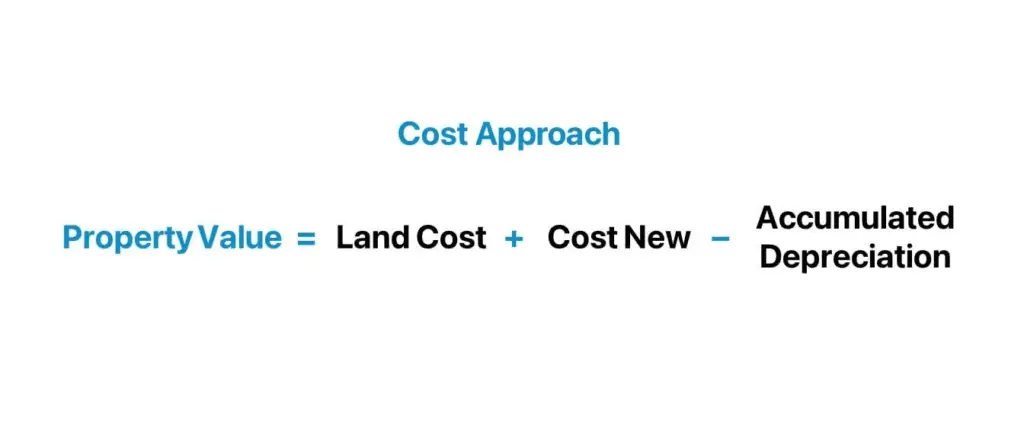
The Cost Approach values a property based on the cost to construct a similar one, minus depreciation, plus land value
How It Works
- Estimate replacement or reproduction cost of the structure.
- Subtract depreciation (physical, functional, locational).
- Add current land value.
- The formula: Value = Replacement Cost – Depreciation + Land Value
Benefits & Limitations
- Very useful for new builds, special-use assets, or where income is irregular.
- Less effective in established markets where sales data and income streams matter more.
- Depreciation estimation can be subjective.
Reconciling the Approaches
Appraisers often use all three methods and weight them based on property type and data quality:
- For income properties: Emphasize the Income Approach.
- Where active comps exist: Lean on Sales Comparison.
- For new or unique properties: Cost Approach becomes crucial.
Step-by-Step Appraisal Process
- Define Scope & Value Type
Under USPAP guidelines, clarify intended users, purpose, value definition (i.e., market value), and effective date. - Collect Data
- Income: rent rolls, lease terms, expenses
- Sales: recent transactions of similar properties
- Costs: construction pricing and land data
- Apply Each Method
- Income: compute NOI, choose cap rate, or run DCF or GIM
- Sales Comparison: adjust comp sales
- Cost: calculate replacement cost minus depreciation + land
- Reconcile Results
Weigh each method’s output based on data reliability. For NNN properties, Income Approach typically leads. - Report Findings
Deliver a formal appraisal detailing assumptions, data sources, and market rationale.
Preparing for an Appraisal
Provide these to your appraiser to boost accuracy
- Rent rolls & lease agreements
- Operating expenses statements
- Comparable sales & market research
- Construction cost data (if relevant)
- Documentation of issues or capital needs
Art Of Commercial Real Estate Appraisal
The art of commercial real estate appraisal lies in melding quantitative methods with seasoned judgment. While the Income Capitalization Approach often carries the most weight, especially for income-producing assets—all three approaches enrich the valuation framework.
By understanding how NOI, cap rates, comparable transactions, and replacement costs interplay, you can:
- Make strategic investment decisions
- Negotiate with confidence
- Accurately assess portfolio value
For expert guidance —rooted in triple-net investments, explore Brisky’s services or contact our team for a consultation.